Categories
Featured News Online Marketing Social Media Marketing Uncategorized Web Development

How Facial Recognition and iPhone X Changes Marketing

How iPhone X’s Facial Recognition Will (and Won’t) Change Marketing

The iPhone X is (almost) here. And it’s got smoother bezels! And a nicer camera! And it retails for approximately $400 more than your iPhone 8. And if you’re not sure how you feel about that…

Well, the iPhone X will soon know exactly how you feel about that.

Most of the discussion about iPhone X has rightly focused on its Face ID feature, a facial recognition system that authenticates multiple images of your face to unlock the device and authorize payments. Just as Touch ID captures your fingerprint from various angles, Face ID captures and compares multiple images of your face, relying on its sophisticated TrueDepth camera system to provide a level of detail previously unseen in camera phones. The feature is programmed to watch and learn how your face changes over time. According to Apple, you can wear glasses, put on makeup, or grow a beard. Face ID will know you anywhere.

Many security and privacy issues have yet to be resolved. However, the device’s ability to read, store, and learn from subtle facial expressions, combined with Apple’s massive install base, makes the iPhone X the key to building the world’s largest database of human emotions. Depending on how (or if) Apple plans to distribute that data, this single feature could revolutionize how brands market to consumers on their phones. For example…

#1: Say Goodbye to Liking Things

Facebook’s Like Button is unquestionably its most powerful brand asset. It has revolutionized how we measure engagement and social currency. And if the iPhone X takes off, it is about to become a dinosaur.

The Like button is popular but imprecise. Did you like this video a lot more, or only slightly more, than the last one you liked? Were there any parts you liked more than others? And by the way, what do you mean by “like”? It was this need for greater precision that led Facebook to introduce its successful lineup of six reactions… but even that cannot possibly compare to the breadth and depth of facial responses that Face ID is able to capture and interpret. Advertisers will be able to see precisely how consumers are reacting to ad content, in real time, requiring absolutely no action on the user’s part.

#2: Say Hello To Your Branded Self

One of the iPhone X’s more lighthearted innovations, Animoji uses your voice and facial expressions to create animated emoji loops you can send as messages. Beyond the fun of seeing how you’d look as a poop emoji, this technology will create massive opportunities for brands, particularly in the realm of entertainment. Imagine being able to create emotionally expressive videos of yourself as Buzz Lightyear or Deadpool… or pretty much anyone.

#3: Chatbots Will Become Care Bears

From your bank’s customer service line to Mattel’s Hello Barbie, chatbots are now dwelling among us and doing fine. Upgraded with emotional intelligence (as with this prototype  Emotional Chatting Machine), customer relations management is about to become a lot more responsive.

#4: How You Feel Will Change What You See

Although it may conjure up Minority Report-like visions of ads talking back to you, emotionally aware advertising isn’t as far away—or as radical—as you might think. Facebook reactions have already influenced how advertisers create content to elicit certain emotions. The day when ad content can be targeted to how you’re feeling—or how much weight you’ve gained recently, or how closely you’re paying attention to the ad—isn’t that far from the here and now.

#5: What Won’t Change: Consumers Get the Last Word

Facial recognition isn’t the future of advertising: it’s the present. Tesco, Google, Facebook, Nike, and Virgin Mobile have already experimented with content that’s customized based on face recognition and user responses. Now that Apple’s on board, the experiment is poised to become a common feature of the advertising landscape. The job of advertisers will be to provide a superior experience that rewards consumers for participating in the experience. If they decide they’re getting fair value, then their faces truly are their fortunes.

Get a jump on the future. Social Link is a team of social media experts who know how to translate today’s technology into tomorrow’s results. Get in touch and let’s get started!

#    #    #

Categories
Uncategorized

Possibilities vs. Pain Points: Which Message is Better?


When you’re developing a message for inbound marketing, is it better to address pain points or suggest possibilities? We explore different marketing message approaches to test conversions. Consider two different approaches to the same product.

Keep Watch On Your Pets 24/7 With PetLook

Does your dog bark as much as the neighbors say? Are your kitties tearing up the sofa? Stop worrying and get PetLook—the pet monitor that lets you give commands, hand out treats, and keep the peace.

Stay Close To Your Pets With PetLook

Life isn’t the same when you’re away from your pets… and you know the feeling’s mutual. More than a monitor, PetLook is just like being home. Let them hear your voice. Send treats. Share the love.

The first version speaks to an established need, the kind that’s likely to come up in a Google search. Yet by isolating a problem, it also highlights a negative: it reminds us that animals are basically a pain in the butt. This amplifies the utility of the product but diminishes its aspirational value (you don’t get a pet just so you can have something to keep off the couch).

Rather than solving problems, the second version suggests possibilities, offering the product as a medium for closeness between pet and owner. It’s better for brand value but limited by a lack of precision. Search “keep watch on your pets” and you’ll get listings for pet monitors. Search “stay close to your pets” and you’ll get a whole bunch of options, ranging from monitors and boarding to pet-friendly restaurants.

Faster Horses (In Different Colors)

“If I’d asked my customers what they wanted, they’d have said faster horses.”  Henry Ford didn’t really say this, but he was still right on the money. Customers are generally good at articulating their needs and will respond well to anything that promises to do it better. What they usually can’t describe are all the possible ways the product could affect their lives… because they generally don’t know what those possibilities are until the marketing tells them (or “inspires,” to use a friendlier term).

Such was the case with the iPhone. To paraphrase the quote above, if you’d asked consumers in 2006 what they wanted in their cellphones, they’d have described ways to make a better phone: “I need an external antenna that won’t break off,” “The buttons are too small.” Smartphones existed, but their appeal was limited. Why pay more for a tiny computer that you have to type on with your thumbs? What do you really need it for?

Then Steve Jobs showed us why. He did succeed in making a better smartphone—but that, as the ad campaign told us, was only the beginning. Sleek and fluid, the iPhone was an expression of style. It was linked to an online store that always had new and exciting apps to try on an impulse. The marketing didn’t tell us, “we just made smartphones less annoying and pretentious.” As Jobs explained, the iPhone was “like having your life in your pocket.”

This is epic brand storytelling—but then again, nobody’s going to type “I need my life in my pocket” into a search window. Inbound marketing works by responding to a need; the job of brand storytelling is to uplift that need into something higher. Clearly, there’s something to be gained by making both approaches work together.

Better Get Better

The key word here is “better.” Consumers don’t always know what they want in life, but they know what will make their lives better. This provides a great opportunity to pivot. They come to you thinking that “better” means a quieter pet. You answer that “better” also means remembering why they got a pet in the first place.

Let’s say that your search campaign targets specific queries (“How do I keep my dog from barking while I’m at work?”) while your social content is aimed at emotional uplift (a video of a pet owner singing a long-distance duet with her parakeet). Although these seem like different approaches, they actually have something important in common: they’re both about about better communication with your pets.

This refines the positioning. Suddenly the PetLook is no longer a “monitor,” it’s a private social network with your pet. You could drive this home with a display ad that shows a quiet, obedient dog looking into the PetLook, hearing only Her Master’s Voice while the copy reads: “SIT. STAY. SPEAK. You talk, they listen.” Both the need for better discipline and the desire for close contact are addressed.

A product isn’t just about fulfilling a need. As with Ford, Apple, and the not-available-in-stores PetLook, it’s also about helping customers discover new needs to fulfill. By taking a closer look at where all those needs intersect, it’s possible to have the best of both worlds.


Whether you’re trying to solve problems or pursue possibilities, Social Link has the in-house expertise to support your marketing needs. Get in touch and let’s get started!

Categories
News Web Design Web Development

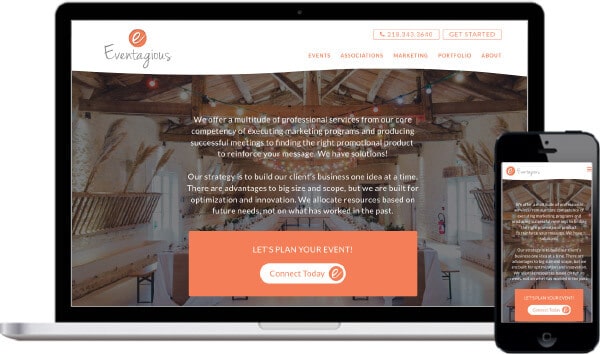
Our Excitement is Contagious: Rebranding Eventagious

Eventagious: It's contagious

With more than thirty-two years in events planning, Leanne Joynes knows how to turn out a crowd. That’s why it was such a pleasure working with her to rebrand her event planning and management agency, Eventagious. She understands the power of social connections.

“Eventagious is what happens when the word of mouth is so spectacular that you have to turn people away,” says Joynes of her company’s new label. “It’s guests who are still talking up an event months after it’s over. The excitement is contagious.”

Joynes engaged Social Link to take the helm on all aspects of the new brand launch: marketing strategy, visual identity, social marketing, SEO/SEM, and web design. The goal was to reposition the company (formerly known as Success Unlimited) as a new kind of event planner.

“The key word in today’s marketplace is agility,” says our own CEO, Brady O’Rourke. “This is something that we, as a virtual marketing agency, understand very well. Our primary communication is that Eventagious is built to scale rapidly. This makes the company attractive for short-term, project-based engagements, while still messaging stability to the clients Leanne’s worked with for years.”

To serve this mission, Eventagious will scale up projects from a smaller, highly skilled core team of Certified Meeting Professionals (CMP). Joynes, a veteran CMP, was a founding member of the International Special Events Society (ISES) and will continue to focus on what her company does best: using creative, organizational, and insider expertise to help manage associations and their event needs. This includes nonprofits, as well as franchise associations within the food and beverage industry: Jimmy Johns, El Pollo Loco, Denny’s, and more.

“We understand the impact that politics can have on business,” Joynes observes. “During the Avian Bird Flu crisis, we were able to help our clients in the food industry organize an effective response to the egg shortage and get what they needed from Washington. Although events are the most visible face of what we do, we’re also very active for our clients behind the scenes.”

Joynes’s own connection with Social Link began two decades ago, when she was an executive in the hotel industry. “Brady always brings a fresh perspective to the table, and he’s always on the cutting edge of new technology. Once upon a time, a different agency told me, ‘We’re going to tell you who’s in your shopping cart.’ That wasn’t good enough for me—I wanted to know who was bailing out of my shopping cart. Brady’s solution was a cart abandonment tool that’s still an industry standard.”

Come check out the new Eventagious. If there’s anything Social Link can do to create some contagious excitement for your brand, talk to us… your virtual marketing department.


Categories
Blog News

Social Link Reinvents Retail For Lake It | Virtual Marketing Agency

Lake It Duluth Retail

Reinventing Retail: A “Virtual Marketing Department” For an Up-and-Coming Lifestyle Brand

In theory, online retail is an open game. In practice, major players still hold most of the cards. Large retailers can afford to build marketing expertise—and market share—without crushing their bottom line. So where does that leave startups?

Possibly stronger than ever. As emerging retailers like Minnesota’s  Lake It are learning, there’s a way to amp up strategic marketing support without firing up the burn rate. The retail site we recently developed for Lake It is the tentpole of the company’s new customer acquisition strategy—and the test case for a different kind of agency-client relationship.

“We’ve come to think of Social Link as our virtual marketing department,” said Justin Steinbach, Lake It’s CEO and president. “Like us, they understand that the future belongs to virtually networked organizations that can scale and adapt much faster than traditional retailers.”

Time to market is the critical factor. Virtual agencies like Social Link have access to a nationwide base of top talent—and can onboard quickly, providing the same calibre of strategic support as an in-house marketing team with far less overhead. Lake It entrusted us with all aspects of customer experience: visual identity, brand storytelling, social strategy, dashboard reporting, and pay-per-click. We’ve even taken a hand in developing new products to enhance the company’s new positioning as a lifestyle brand.

“There’s a niche for every kind of product, as long as you know who you’re trying to reach.” So says our CEO and founder, Brady O’Rourke. “For Lake It, we developed a customer profile around the idea of ‘lake culture’… a whole way of life that was born in Minnesota, and that high-end consumers across the nation are beginning to embrace. Every part of our digital strategy is designed to drive sales and qualified leads with this affinity group.”

If you’ve got big plans for your brand, then let’s talk. We’re ready to bring them to life.

Categories
Uncategorized

Virtual Genius: Why More Great Talent is Working Remotely

Working Virtual: Great for Employees, Awesome For You

Why More Employees are Going Virtual… And Why That’s Great For Your Business

Digital marketing is an increasingly complex business, and the masters of the trade are in high demand. With many opportunities to move to large agencies or small, more and more of these top employees are electing to do neither. Instead, they’re going virtual, choosing to work remotely. Here’s why that’s great news for them… and fantastic news for clients.

A recent HiveDesk survey found that 80% of marketing agencies experienced higher productivity with their remote employees. The reasons cited by hiring managers? Zero commute time, fewer interruptions, less time in meetings, and reduced sick days. But the biggest advantage is talent. Gallup reports that virtual employees are better educated, more experienced, and more self-motivated. They can work anywhere, so they choose to work from home.

Small wonder that virtual employees are generally happier in their work (according to a TinyPulse, 8.1 satisfaction on a 1-10 scale, compared to 7.44 for office-bound employees).

The benefits to employees flow straight to the bottom line. Virtual agencies aren’t forced to hire locally or relocate—they can find talent where it lives. That, plus the savings in office-related costs, gives virtual agencies a competitive edge.

If you’re great at what you do and thinking about going virtual, let’s talk. If you’re a business looking for strategic digital marketing, we’d love to tell you more reasons about the advantages of hiring Social Link… your virtual marketing department.